
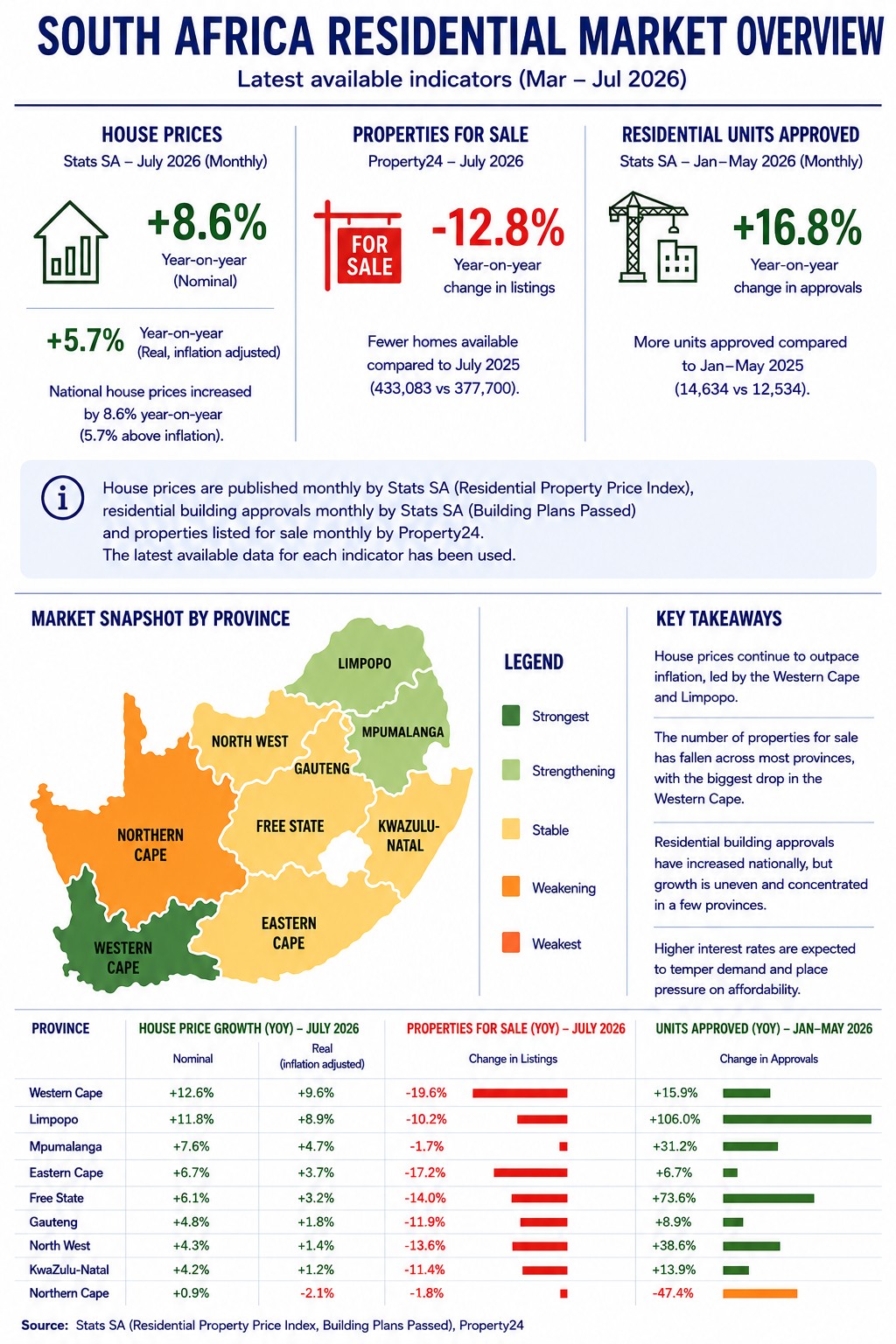
There are some interesting developments in the South African residential market. With growing demand, especially in the affordable housing market segment, house prices have now reached the highest increase dating back to 2011, up 8.6% (nominal) against a 3.1% increase in inflation as at March 2026 (latest available residential price indices published by Stats SA).
One reason appears to be a shortage of available homes. The number of residential properties listed for sale declined by 12% y-y in July, while residential units approved for construction increased by 17% during the first five months of 2026 to around 14600 units. Since the 1st quarter, the increase has slowed, as uncertainty and higher interest rates are feeding into the development pipeline. It is accepted that higher interest rates are likely to dampen the investment mood to some degree, but within the right affordability segment, demand is now so high, that limited supply will continue to put upward pressures on house prices, creating a more favourable environment for new developments.
The Western Cape continues to stand out, with house prices up 12.6% (9.6% in real terms) combined with the largest decline in available properties for sale (-16.1%), reinforcing just how tight this market has become. In terms of approvals for new housing units, Limpopo (+106.0%), Free State (+73.6%), North West (+38.6%) and Mpumalanga (+31.2%) recorded the strongest growth in residential building approvals, pointing to increasing development activity outside the traditional major markets.
Higher interest rates are likely to slow demand and moderate house price growth over time as affordability comes under pressure. But if the residential market remains in short supply, particularly in these high-demand provinces like Western Cape, prices could continue to outperform inflation.
Supply is simply not keeping up with demand. And that is a trend worth watching.
Residential Property Price Index (March 2026) and Provincial Residential Indicators