
Performance in 2021
Today, Stats SA released the private sector building statistics for December, which now gives us a full view of activity levels and approvals in 2021, and it isn’t pretty. The data shows that the private building market was still operating at an extremely low level in 2021, compared to pre-pandemic ‘normal’ levels of activity. In fact, according to Stats SA, the private building market was operating at a measly 65 percent of 2019 levels of activity, in terms of SQM reported as completed. There were just 7.4 million SQM completed in 2021, compared to 11.3 million in 2019, which is a huge loss of activity, with the size of the market shrinking more than 35 percent, which is quite a staggering contraction. There was of course an increase compared to 2020, up by 18.9 percent, but this was nowhere near good enough to return the market to ‘normal’ levels.
The office space segment has been completely decimated, and somehow there was actually less office space built in 2021, compared to the pandemic ravaged 2020, in which there were a few months when contractors could not physically even be on site. There were just 190 000 SQM of office space reportedly built in 2021, which is down more than 50 percent from 2020, and down almost 70 percent from 2019 levels which is quite staggering. There has unfortunately been a structural shift within the office space market, in that we expect there to be a permanent loss in the size of the industry going forward. The industrial and warehousing segment was also particularly bad, with less warehouses built in 2021 compared to 2020 as well, down by 12 percent y-y. There was reportedly 945 000 SQM completed in 2021, compared to 1.07 million in 2020 and 1.4 million in 2019.
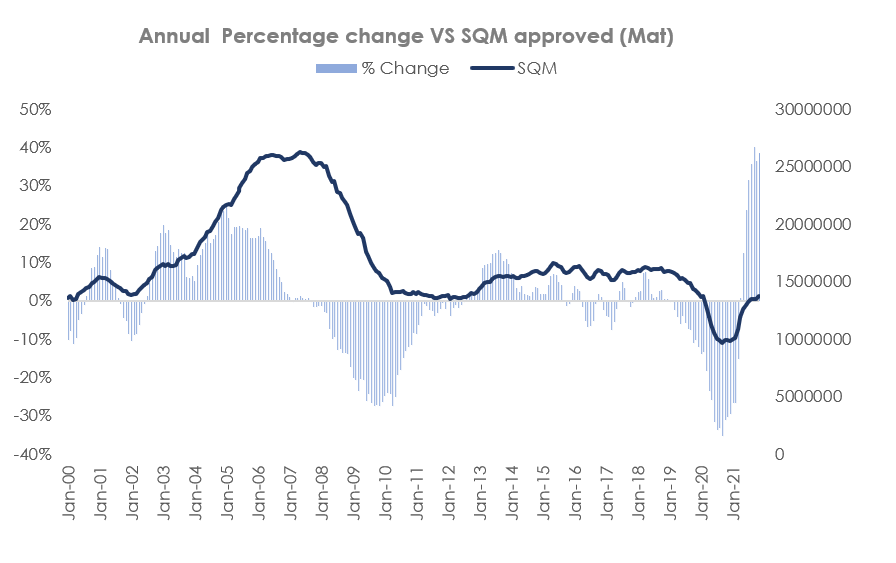
Housing has been the most positive segment by far, and the number of free-standing houses built in 2021 almost got back to pre-pandemic levels, which is good. Overall however, the residential market was also far off pre-pandemic activity levels in 2021, with 5.1 million SQM completed compared to 7.7 million in 2019, with poor figures for flats and townhouses. Demand does seem to be a lot more robust however, if we look at building plans approved.
Outlook
For the overall building industry, the outlook unfortunately remains poor, with several headwinds, the biggest being a severe lack of economic reform. While there has undoubtedly been some progress, it is far too slow and nowhere near enough, with the majority of the ANC seemingly uninterested in implementing any sort of major reforms to boost the economy and stimulate demand and investment. One of the biggest problems facing the economy has been a severe lack of investment by both the government and the private sector. On the public side, the capacity of the government in the form of SOE’s and municipalities has been eroded so much over the last 10 years or so, that they seem completely incapable of effectively spending infrastructure budgets and making other investments in the economy, rather focusing on short term policies. Their finances are obviously also in disarray, with an unsustainable amount of debt also proving to be a challenge. In terms of the private sector, confidence is around all time lows, with the current policy environment just too uncertain, which will not incentivise any major private sector investment.
The SQM approved data is however a lot more encouraging for the residential market, with the number of SQM approved actually exceeding 2019 levels, which is excellent, so we are expecting further recovery next year. The same cannot be said for the non-residential sector however, and with the industry facing higher interest rates over the next 12-18 months, this is sure to also curtail demand.
Clients can download the dashboards which are monthly summaries below: